Trying to choose between a brand-new home and a classic Northbrook house? It is a common question, and in this market, the answer is not always as simple as newer is better. If you are weighing layout, upkeep, taxes, and neighborhood feel, the right fit depends on how you want to live now and what you want your home to offer later. Here’s how to compare Northbrook new construction and classic homes with more confidence.
Northbrook is not a blank-slate suburb with endless new subdivisions. It is a mature, largely owner-occupied community with 34,546 residents, an owner-occupied housing rate of 87.2%, and a median owner-occupied home value of $652,300. That matters because the housing stock reflects decades of growth, not just recent building.
Most of Northbrook’s big residential growth happened after World War II, when subdivisions were first developed. Today, the village describes itself as a built-up community with limited land left for new residential development. In practical terms, that means many “new construction” opportunities are infill homes or teardown-and-rebuild projects, not large new neighborhoods built all at once.
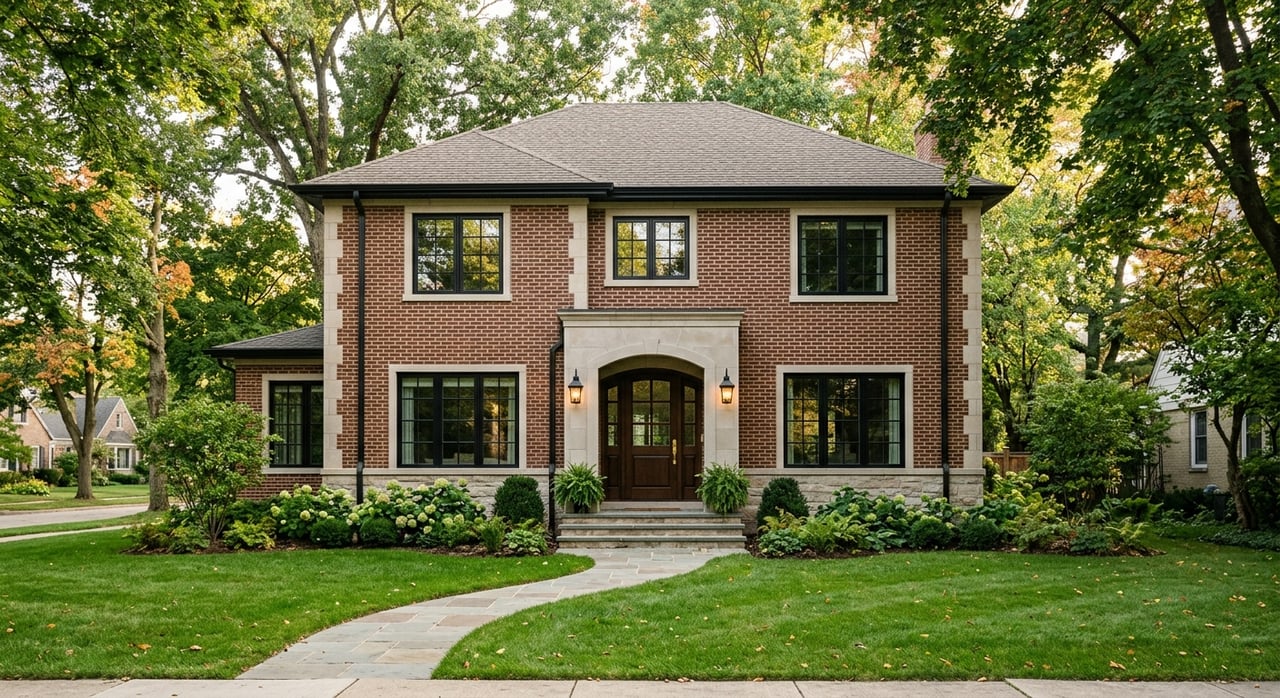
If you picture brand-new homes on freshly opened streets, Northbrook may look different than expected. Because land is limited, new homes here are often created one lot at a time. You may see a newly built house next to established homes rather than inside a fully new subdivision.
That local pattern affects price, timing, and expectations. A teardown-and-rebuild can carry extra costs before the new house is even complete, and local rules matter more than many buyers realize. In Northbrook, it is smart to evaluate each property by its address, lot, and permit history rather than assume every new build follows the same formula.
Northbrook’s permit process for a new single-family home is detailed. A permit package includes a building permit application, a Monotony Housing Review application, a zoning worksheet, building site and utility data, a water service and meter worksheet, a whole-house mechanical ventilation worksheet, and solar and EV-ready provisions.
That tells you something important as a buyer. New construction in Northbrook is tightly planned and reviewed, which can be appealing if you want a home built around current standards rather than one that needs immediate updates.
If a home was built after a demolition, the numbers behind that project may help explain the asking price. Northbrook charges a $10,000 demolition tax for certain single-unit residential demolition permits filed on or after January 1, 2021, plus a $750 building construction and inspection fee and a $5,000 right-of-way damage deposit or demolition escrow.
Those costs do not automatically make a home overpriced. They do show why some new construction carries a premium before materials, finishes, and labor are fully counted.
For many buyers, the biggest draw is peace of mind. A new home is the clearest path to current-code systems and energy performance without starting a renovation project right away.
Illinois says the 2024 Illinois Energy Conservation Code became effective for residential buildings on November 30, 2025. Northbrook’s checklist for new single-family homes also includes whole-house mechanical ventilation plus solar and EV-ready provisions. If you want modern systems from day one, new construction has a clear edge.
You may prefer new construction if you want:
That does not mean every new home is automatically the better value. It means the value often comes from convenience, efficiency, and lower immediate update pressure.
Classic homes are not the fallback option in Northbrook. They are a major part of what defines the market. Because the village developed heavily in the postwar period and is now largely built up, established neighborhoods are one of Northbrook’s core housing strengths.
For many buyers, a classic home offers something new construction cannot easily recreate. That might be a more settled streetscape, a different lot feel, or the chance to personalize the property over time.
Northbrook’s older housing stock is closely tied to its established residential pattern. If you are drawn to mature streets, existing landscaping, and a neighborhood that feels fully formed, classic homes often deliver that experience more consistently.
That can matter just as much as square footage. Some buyers are happy to take on updates if it means living in a part of town with a feel they strongly prefer.
One of the most useful things to know about Northbrook is that lot experience can vary a lot by zoning district. Interior lot area ranges from 50,000 square feet in R-1 to 7,500 square feet in R-5. Lot widths range from 175 feet to 60 feet, and front-yard setbacks range from 60 feet to 25 feet.
The takeaway is simple: lot feel is highly district-specific. Two homes in Northbrook can have very different spacing, frontage, and overall presence, even if they are similar in age or price.
Northbrook’s permit pages also show the range of projects homeowners commonly take on over time. These include additions, major renovations, interior alterations, water-service upgrades, sewer repair, and water-heater replacement.
For you as a buyer, that means a classic home can offer flexibility. You may not get every feature on day one, but you may gain the ability to improve the home in stages based on your budget and priorities.
One of the biggest real-world differences between new construction and classic homes is how the layout fits your daily life. New construction is usually designed with a more current planning approach, and the permit process reflects that level of upfront coordination.
Classic homes can feel different from one property to the next. Some buyers see that as a downside, while others see opportunity. If you can picture reworking rooms or adding on later, an established home may give you more room to create the fit you want over time.
If energy performance is high on your list, new construction usually has the cleaner story. It is built to the current Illinois energy code, and Northbrook’s checklist specifically calls for mechanical ventilation and solar and EV-ready provisions.
Classic homes can still be excellent purchases, but they come with more variation. One older home may have substantial updates already completed, while another may need future work on efficiency, systems, or infrastructure. That is why age alone is not enough. Condition matters.
When buyers compare homes, it is easy to focus on price per square foot or finishes. In Northbrook, the full property tax picture deserves just as much attention. The village’s annual financial report shows that local property taxes are shaped by several overlapping taxing bodies, including Cook County, the township, the park district, school districts, the library, and sanitary districts.
That means your long-term cost is not just about the purchase price. When you compare a new construction home with a classic one, review the full tax bill carefully. A higher-priced home and a lower-priced home may not feel as far apart month to month as you expect, or the reverse may be true.
If school assignment matters to your home search or future resale, check it by property address. In Northbrook, District 27 serves the northwest, District 28 the northeast, District 30 the south, and District 31 the southwest. Glenbrook North High School serves the village at the high school level.
Because boundaries vary by address, school assignment is a major variable for both classic homes and new construction. It is not something to estimate based on neighborhood reputation or nearby streets. It should be confirmed property by property.
In Northbrook, age alone is not the best predictor of resale strength. A brand-new home may stand out for systems and convenience, while a classic home may stand out for lot, location, or update potential.
In many cases, the more important factors are:
This is one reason a local, property-specific approach matters so much. Two homes that look similar on paper can perform very differently over time.
If you want a home that feels turnkey and aligns with current construction standards, new construction may be the better fit. If you care more about established surroundings, lot variety, and the chance to shape the home over time, a classic property may offer more of what you want.
The best choice usually comes down to your tolerance for future projects, your monthly budget including taxes, and how much weight you place on layout, systems, and neighborhood feel. In Northbrook, both paths can make sense. The key is comparing the right details, not just the listing photos.
If you are weighing homes in Northbrook or elsewhere on the North Shore, Julie Bird can help you compare properties with a local, practical lens and guide you toward the right fit for your goals.
We are committed to guiding you every step of the way—whether you're buying a home, selling a property, or securing a mortgage. Whatever your needs, we've got you covered.
Contact UsAddress
Evanston, IL
Julie Bird
(480) 250-5832
[email protected]
Emma Bird
(480) 299-1810
[email protected]
Catherine Riddle
(847) 609-8352
[email protected]